How to Examine an Off-Center Coin Strike
Errors & varietiesBy Coinzy Editorial Team
· 3 min read
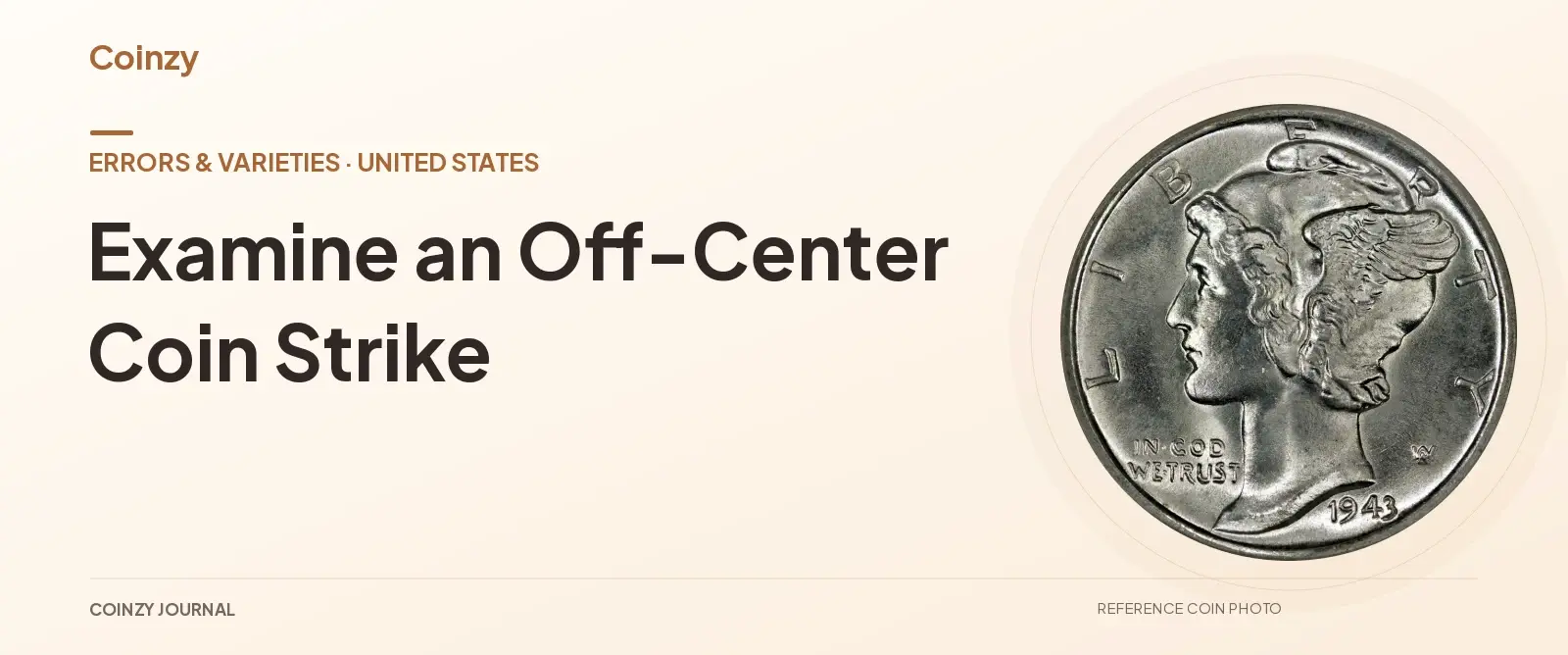
Thumbnail: 1943D Mercury Dime obverse-cutout.png by BrandonBigheart for the photograph; Adolph Weinman for the coin design.. CC BY-SA 3.0. Cropped, resized and composed with title and background.
An off-center strike can leave part of the design missing because the planchet was not correctly positioned during striking. Confirm the nature of the displaced design before treating an unusual rim as a mint error.
What should you know about examining an apparent off-center strike?
Photograph both faces and the edge, and note which design elements are absent. Compare the displacement with the coin’s original shape rather than judging a cropped photograph alone.
Which evidence should you use?
PCGS distinguishes off-center errors from die varieties, while NGC’s broadstrike discussion contrasts incomplete off-center designs with broadstrikes that retain the full design. These distinctions guide the questions to ask.
PCGS: Varieties and Mint ErrorsWhat mistake should you avoid?
A missing or uneven-looking border does not by itself establish a valuable off-center error. Damage and other striking conditions require different explanations and can affect the assessment.
How does this work in practice?
A coin has an unusually broad rim but retains the entire design. Compare broadstrike and alignment explanations instead of assuming that every asymmetry belongs to the same category.
For examining an apparent off-center strike, begin with a neutral observation and then test possible explanations against the photographs and reference. Write down which visible feature each explanation accounts for. If an explanation requires ignoring the reverse or edge, the evidence set may be incomplete rather than the attribution secure.
Keep an unedited photograph alongside any enlarged detail. Describe the location of the feature using nearby lettering or design elements so that another person can find it. With examining an apparent off-center strike, a reviewer needs to see the same evidence you saw, not just the name of the error you suspect.
Ask a narrow question when requesting help: which manufacturing or damage process best explains the visible feature, and what additional view would distinguish the alternatives? An answer that identifies a missing piece of evidence can be more useful than a confident label based on an inadequate image.
What should your next steps be?
- Capture complete front and back photographs.
- Record the readable date and mint mark.
- Inspect the edge for later damage.
- Compare the design’s position with normal examples.
- Ask a specialist to identify the error type.
Work through the checklist in order and keep the outcome of each step with your record of examining an apparent off-center strike. If a step cannot be completed, state the missing information explicitly. This makes it easier to ask for the right photograph, reference or professional opinion instead of substituting a guess.
When is more evidence needed?
Preserve the coin and the evidence together. Pricing should follow a defensible error attribution and condition comparison, rather than the visual drama of the photograph alone.
Frequently asked questions
Can a photograph settle the question on its own?
A photograph can help with examining an apparent off-center strike, but its usefulness depends on the visible detail and the question being asked. Request complete views and a relevant close-up when necessary. If the outcome depends on an unseen surface, an exact measurement or physical authentication, explain that limitation and seek the appropriate assessment.
What should I keep in my collection record?
Keep the coin’s identification, the images you examined and the source behind the conclusion about examining an apparent off-center strike. Add the transaction or assessment documents when relevant, and distinguish a confirmed fact from an opinion. Update the record when later evidence changes an important detail rather than silently replacing the original account.
How should you use a professional opinion?
Ask the reviewer to explain the scope of the answer about examining an apparent off-center strike: what evidence was examined, which conclusion it supports and which questions remain open. Keep that explanation with the original record. A useful opinion should help you choose a next action, such as obtaining a clearer image, checking a reference or arranging physical examination; it should not require you to ignore information that conflicts with the conclusion.
Where can you continue your research?
Browse the Coinzy catalogueRead more collecting guidesUnderstand the Sheldon grading scaleU.S. Mint: Caring for Your Coin CollectionCoinzy Editorial Team
Coinzy publishes practical coin collecting, identification and marketplace guides with links to the references used. Coin-specific authenticity and grading questions may require an independent expert assessment.