Ancient Roman coins
14k+ coins · up to $50,000
Browse Catalogue
Explore popular collecting categories, from ancient Roman to rare American.


Want to check your coins value? Get it evaluated first, then list to verified buyers.

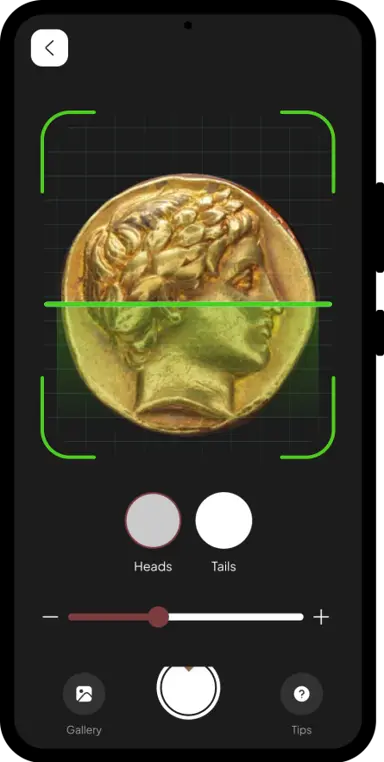
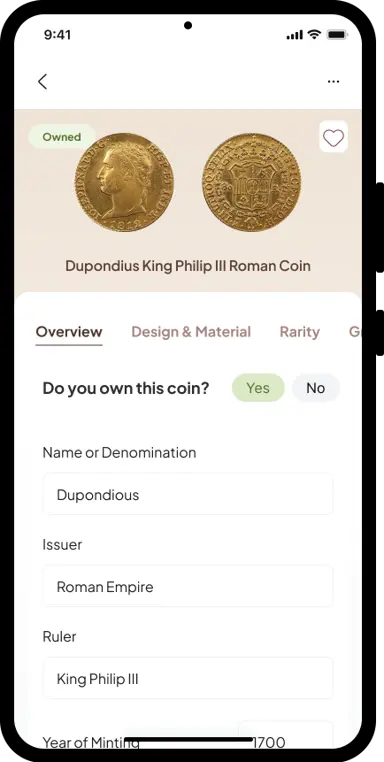
MOBILE APP
Identify coins using your camera. Your collection syncs across devices.
1M+
Daily users
4.3+★
User feedback rating
1.5M+
Items cataloged
20K+
Community members


Estimated Value
No recent market data yet
Name or Denominations
Potin Unit
Issuer
Cantii tribe (Celtic Britain)
Ruler
NA
Year of Minting
95 BC - 80 BC
Currency
Stater
Shape
Round (irregular)
Rarity
Ultra rare
Weight
1.5 g
Diameter
16.1 mm
Thickness
NA
Material
Potin
Shape
Round (irregular)
Edge Type
NA
Technique
Cast
Front design
Outline head of Apollo right, head outline and profile replaced by a fully continuous circle, with or without neckline, eye ring with pellet.
Back design
Outline bull right, curved, very crude, usually one detached crescent above. Exergual line below.
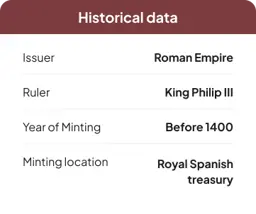
Year of Minting
95 BC - 80 BC
Ruler
NA
Mint location
NA
Mint mark
NA
Orientation
9 o'clock ↑←
Inscriptions
NA
Context
Van Arsdell ‘Rounded Bull’. David Holman proposes a detailed classification in A New Classification System for the Flat Linear Potin Coinage . This type corresponds with his Group D, which derive from Holman Group C . Holman characterises Group D (Allen F5-7, GC1-2, J1 and J5) as having large flans and striations like Group C but similarities in the obverse to Group E. Crude designs and striations are common. There is often a pellet in the eye ring. The bull is curvilinear with either one or two crescents above, the tail sometimes leading straight into what looks like a crescent but is taken to be part of the tail. Given the variability of the series, Holman suggests a degree of flexibility, where the features given are not taken to be exact. There are seven subgroups in Group D, of which this is the fifth: Subgroup D5 is rare, with unusually crude designs, poorly cast with incomplete designs. They are usually 15.5-16.5mm and 1.1-1.8g, and always have a reverse orientation of 9h. Uniquely, the central neck line is replaced by a continuation of the head outline to join the now unrecognisable profile, the result resembling an archery target. Next in the chronological sequence is Holman D6 . The previous type is Holman D4 . The previous group is Holman C and the next is Holman E . The illustrated coin is in the Portable Antiquities Scheme database ( CC BY 2.0 ).
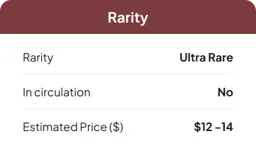
Rarity
Ultra rare
Coin type
Standard circulation
In circulation
No
Demonetized
Yes
Marketplace listings
0

Subscribe to Premium
Unlock more coin details with Premium.