Ancient Roman coins
14k+ coins · up to $50,000
Browse Catalogue
Explore popular collecting categories, from ancient Roman to rare American.


Want to check your coins value? Get it evaluated first, then list to verified buyers.

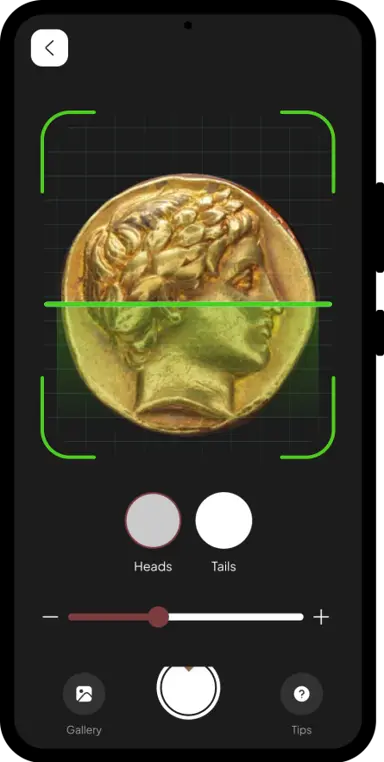
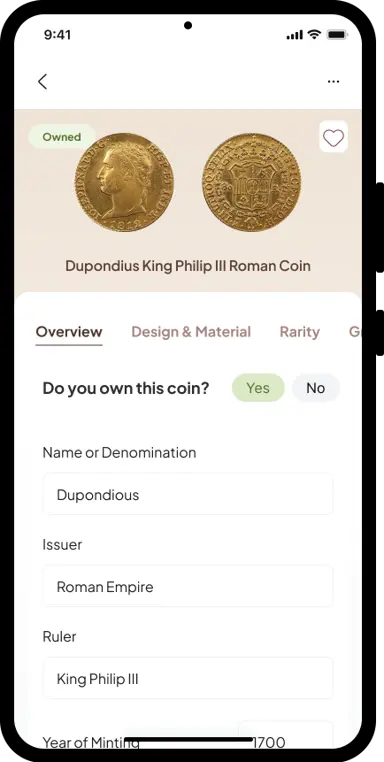
MOBILE APP
Identify coins using your camera. Your collection syncs across devices.
1M+
Daily users
4.3+★
User feedback rating
1.5M+
Items cataloged
20K+
Community members


Estimated Value
No recent market data yet
Name or Denominations
Potin Unit
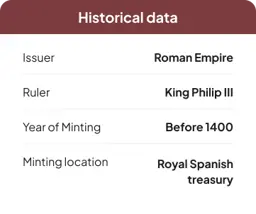
Issuer
Cantii tribe (Celtic Britain)
Ruler
NA
Year of Minting
60 BC - 45 BC
Currency
Stater
Shape
Round (irregular)
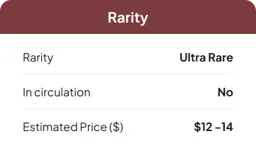
Rarity
Ultra rare
Weight
1.2 g
Diameter
12.5 mm
Thickness
NA
Material
Potin
Shape
Round (irregular)
Edge Type
NA
Technique
Cast
Front design
Crude outline head left, right or indeterminate, large pellet in eye ring, no head outline.
Back design
Crude outline bull of straight lines, indeterminate direction, central pellet, one crescent above. Exergual line below.
Year of Minting
60 BC - 45 BC
Ruler
NA
Mint location
NA
Mint mark
NA
Orientation
Variable alignment ↺
Inscriptions
NA
Context
Evans: H8 (1864, p. 123 , pl. H ). Allen Type: P1, P2. Mack 25: Class 2 (small module). Extreme degradation of head, which is now two circles with a pellet in centre. Square enclosing pellet (Allen P). Van Arsdell ‘Dump Type’. Van Arsdell Classification: Cantian E, Adjustment Period . His corresponding variety is: VA 139 - 01 (Late Dump Type, 45-40BC, Holman G3/6-1): Obverse head of Apollo now only a circle with a line for the nose, pronounced pellet in centre. Reverse barely recognisable bull made up of straight lines, pronounced pellet in centre of coin. Chris Rudd (ABC) ‘Nipples’. David Holman proposes a detailed classification in A New Classification System for the Flat Linear Potin Coinage . These coins correspond with his Group G, which derive from Holman Group F . Holman characterises Group G (Allen Class II) as the latest and most degraded of the series and have a significantly smaller diameter (11.0-14.5mm). Striations appear for the final time in the early stages of the group. The crudity of the designs and number of variants makes detailed classification problematic. Given the variability of the series, Holman suggests a degree of flexibility, where the features given are not taken to be exact. There are four subgroups in Group G, of which this is the third: Subgroup G3 (including Allen P) has crude, barely recognisable designs bearing very little resemblance to Groups A to F. The obverse is dominated by the eye ring and central pellet and any attempt at an outline head has disappeared, although the facial crescents survive until the very last stages. The reverse is also dominated by the central pellet and the bull is little more than an abstract pattern of lines. There is usually one crescent above the bull. Coins are 12-13mm and 0.9-1.3g. There is a vairant of G3/6-1 with two necklines, which Holman thinks is a die flaw. See CCI 06.0754 . Next in the chronological sequence is Holman G4 . The previous type is Holman G2 . The previous group is Holman F . The illustrated coin is in the Portable Antiquities Scheme database ( CC BY 2.0 ).
Rarity
Ultra rare
Coin type
Standard circulation
In circulation
No
Demonetized
Yes
Marketplace listings
0

Subscribe to Premium
Unlock more coin details with Premium.